
Citizen Prosperity Index for east London

The Citizen Prosperity Index is a new way of measuring prosperity that reports on what matters to local communities in east London.
Unlike most indicators and metrics that are decided by experts in government, universities or business, and assumed to be relevant to communities everywhere, the Citizen Prosperity Index was co-designed with a team of citizen social scientists who conducted in-depth qualitative research to understand the lived experiences of local communities in east London.
About the project
The Citizen Prosperity Index has been launched as part of the Prosperity in east London 2021– 2031 longitudinal study.
This study is a 10-year study tracking the prosperity of over 4,000 households in 15 areas of east London where large-scale and long-term urban regeneration is driving rapid physical, economic, and social changes in local communities.
Led by IGP Professorial Research Fellow Dr Saffron Woodcraft, the study explores how the ‘prosperity gains’ from regeneration investments are shared in and between local communities. It looks at how regeneration affects the prosperity of people from different backgrounds and neighbourhoods in the long-term.
The goal of the research is to fill the gap in research regarding the unequal impacts of regeneration on prosperity, life chances, and quality of life amongst local communities.
The project combines data from the Citizen Prosperity Index household survey, and Obstacles to Prosperity qualitative research, which is undertaken by citizen scientists – local residents employed and trained by UCL’s Citizen Science Academy to work as social scientists in their neighbourhoods.
Methodology
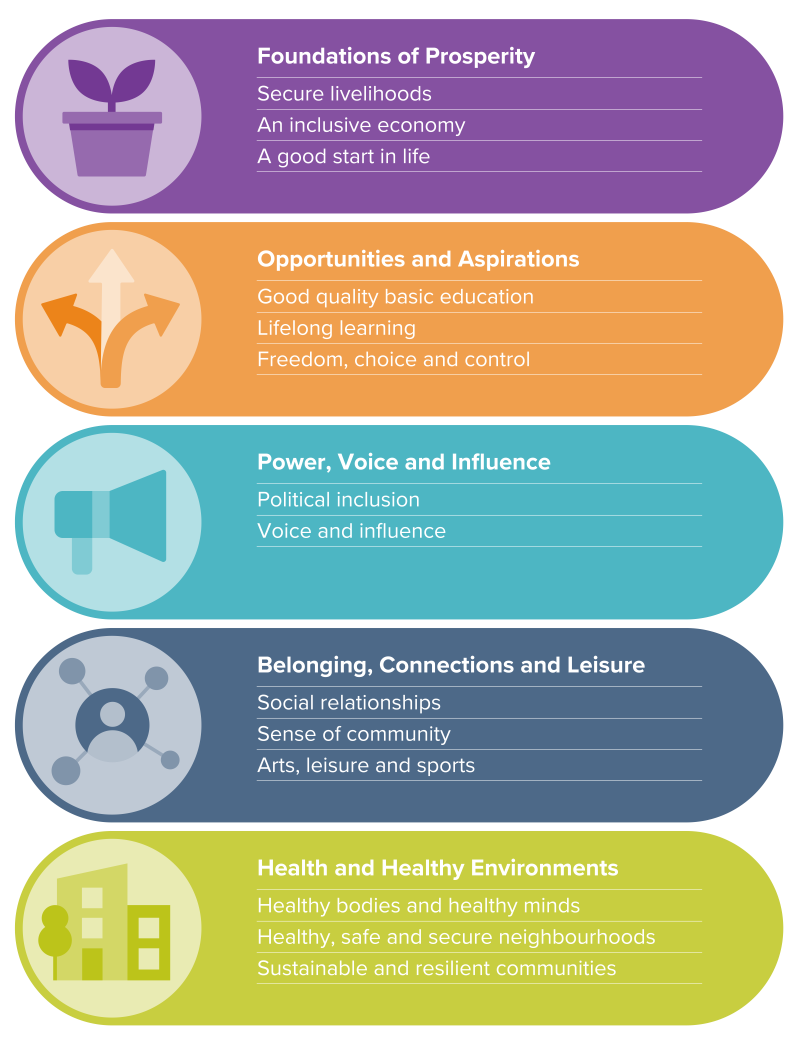
The Citizen Prosperity Index reports on 14 subdomains that were identified as most important to the prosperity of local communities.
Each of the subdomains falls under one of the 5 key prosperity domains:
1. Foundations of Prosperity
2. Opportunities and Aspirations
3. Power, Voice and Influence
4. Belonging, Connections and Leisure
5. Health and Healthy Environments
Using subjective and objective measures from the Citizen Prosperity Index household survey and secondary data sources (e.g. national census data), the study will track, over 3 waves of collection of data, how individuals and households in the 15 areas of east London fare against each of the 14 subdomains, comparing this to Greater London.
Key findings

The Citizen Prosperity Index for east London data shows significant differences in prosperity across the 15 research sites, and identifies intricate, place-specific patterns of opportunity and inequality across gender, age, and for different ethnic groups:
Overall, women generally report lower levels of prosperity than men.
People from non-white backgrounds report lower levels of prosperity than those from white backgrounds.
Older people tend to be less prosperous than younger people.
Men are more likely to report higher Citizen Prosperity Index scores for secure income and work, and freedom from financial stress. While women are more likely to report higher Citizen Prosperity Index scores for social and community-related aspects of prosperity.
Deep-rooted challenges of livelihood insecurity persist across all areas and demographics, not mapping straightforwardly onto employment status and income.
Overall, residents in planned, new neighbourhoods in regeneration areas report higher levels of prosperity than those in established neighbourhoods on the fringes of development sites. This is evident across multiple determinants of prosperity, showing that prosperity gains from regeneration do not ‘spillover’ to disadvantaged communities in neighbouring areas.
Resources
Report
Citizen Prosperity Index for east London: New Evidence and a New Approach to Tackling Inequalities
Impact & Wave 2 Plans
Outputs and Impact from Wave 1 and Plans for Wave 2
Read Now