
The role of the French “mandate” in shaping the current Lebanese reality (English translation with Arabic Original)
Rahaf Zaher
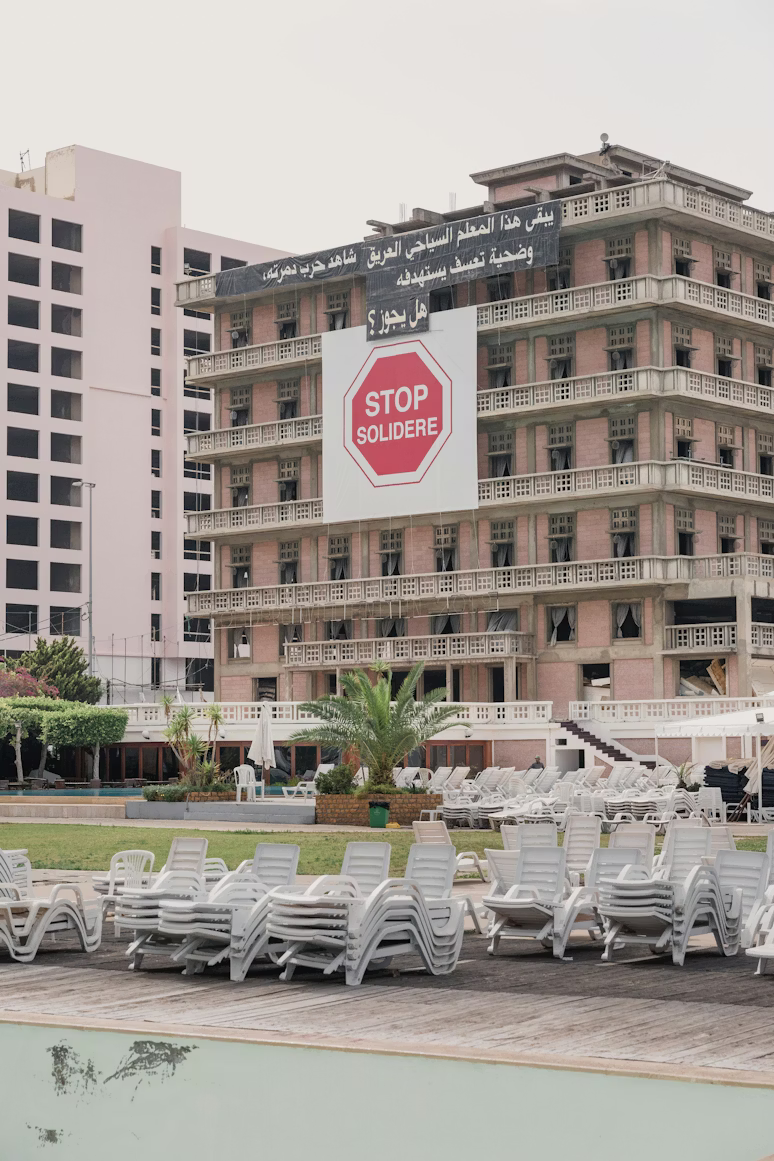
Photo credit: Martin Bjork via Unsplash
23 January 2024 On 22[nd] November 2023, Lebanon celebrated its 80[th] anniversary of independence from the French ‘mandate’ that ended in 1943. This anniversary coincided with the announcement of a temporary ceasefire agreement in the Gaza Strip, Palestine.
This comes after a 48-day-long Israeli aggression that reaped the lives of 14,500 Palestinians, mostly women and children, in addition to the complete or partial destruction of 60% of buildings in the strip, including schools, hospitals, places of worship and United Nations institutions. Figures on the 100th day of war indicate that 25,000 Palestinians were killed in addition to the complete or partial destruction of 80% of buildings in the strip.
On the same day, the Southern border of Lebanon witnessed retaliatory military operations between Hezbollah and the Israeli army, the latter already stationed in seven Lebanese villages and the Shebaa Farms it occupies.
These actions of militarised resistance represent the shared struggle of the anti-imperialists and anti-colonialists of Lebanon and Palestine, reminding us of a past that has been obscured, distorted, and vandalised. Indeed, it is imperative to shed light on the agreement, which aimed at distributing territories previously under the Ottoman Empire into territories of British and French influence.
This ‘mandate’, which was imposed upon the colonised Lebanese people at the time, claimed that its priority was to build their capacity to govern themselves. Instead, in a clear deviation from this objective, one of the major outcomes of the British mandate was the transformation of Palestine, whose borders spanned from the Mediterranean Sea to the Jordan River, into a de facto Zionist colony.
The plan to create a Zionist colony in Palestine was approved and recognised in the First Zionist Congress of 1897. Later on, its seeds were planted through the Balfour Agreement in 1917, propelled and aided by the British mandate of Palestine between 1920 and 1948, and grew strong roots as a result of the global silence in the face of a colonial project that was founded and continues to expand - away from metaphors - on the bodies of Palestinians.
In the 1948 Nakba (Arabic for catastrophe) alone, more than 15,000 Palestinians were killed in the most heinous ways in 531 destroyed Palestinian villages, and more than 750,000 others were forcefully displaced while carrying their house keys. Today, and after 75 years of continuous catastrophes, those who are still alive await their return, while those who passed away left behind generations awaiting their return.
In Lebanon, some historians have resorted to characterising the ‘mandate’ as a “palliative term for occupation. Michael Shahdan Khalifah clarifies that one of France’s main goals in announcing Greater Lebanon in 1920 was an attempt to access fuel resources in the region after the value of fuel was recognised in World War I.
Later, although Lebanon wasn’t transformed into a colony like Palestine, it was left bordering a colonial project that threatened expansion into its lands. Due to its geographic, historical, and political connection to Palestine, a unified resistance against Israel ensued. Following various clashes and amidst a violent civil war between proponents of the Palestinian struggle and Lebanese nationalists, Israel invaded Lebanon in 1978 and occupied the territories south of the Litani River; in 1982, it attempted to occupy more Lebanese territories up to West Beirut. The direct effect of the Israeli aggressions in impoverishing and marginalising the invaded areas, especially those in Southern Lebanon, is clearly evident.
And the continuous struggle against Israel had disastrous impacts on the Lebanese economy, either directly through the destruction of the country’s infrastructure or through isolating it from the international community, especially after the liberation in 2000, and the defeat of Israel during the war in July 2006. Today, aside from the direct ongoing struggles of decolonisation in Lebanon, the nation grapples with various enduring colonial residues that persistently shape its current state.
Upon the declaration of independence in Lebanon, the Minister of Internal Affairs responsible for forming the first Lebanese commission to London in 1944, Camille Chamoun, stated that “the French’s true intention was not to hand over Lebanese rights except inch by inch”, adding that they were not enthusiastic, of course, about handing over the positions they enjoy in Lebanon, and were, at the same time, continuing their efforts in London and Washington to ensure the recognition of an excellent status for France in Lebanon.
After this recognition, General De Gaulle was hoping to coerce us to sign a treaty ensuring cultural, economic, and strategic privilege. Hence, France was evasive in handing over the interests and institutions it controlled in Lebanon, including the military and media outlets at the time. Despite not officially securing recognition for its special status in Lebanon, France maintained its influence as a pivotal decision-making force in Lebanese politics for decades later.
Notably, this influence became particularly evident in the aftermath of the port explosion on August 4, 2020, when the French President Macron visited Beirut and put forth a “French proposal” to address the crises Lebanon was grappling with. During the visit, a number of protestors and participants were seen pleading with the French president to bring back the French mandate in Lebanon.
Tens of thousands of individuals even went a step further and signed a petition demanding the reinstatement of the French Mandate. This incident brings forth a crucial element of the enduring residue of colonisation, that is, ingraining the predisposition to colonisation in the psyches of colonised people. Malik Bin-Nabi explains:
“The Coloniser will not have the ability to control our social and economic energies... if we free ourselves from the psychological issues that attract us towards it and allow it to harness us for its interests. Accordingly, the foundation of liberating ourselves from the impact of this colonisation is to liberate ourselves from its cause, which is the susceptibility to colonisation.”
The beginning of the French ‘mandate’ in Lebanon and Syria brought about significant political changes that transformed the region. The first impact of the mandate was to through a representative civil democracy in Greater Syria in 1920. At that time, the majority of the Administrative Council for Mount Lebanon (7 out of 12 members) had voted to join the government of Damascus, with assurances to protect the rights of all citizens regardless of their religions. However, this alliance was crushed months later by the French invasion of Syria.
Additionally, France had shown favouritism towards the Maronite sect in Lebanon prior to the mandate, and this discrimination continued throughout the various stages of the mandate, further fuelling sectarianism in Lebanon. The French, in an even greater example of exacerbating sectarianism during the declaration of Greater Lebanon, “sought to ensure that the President would be exclusively from the Maronite sect and even refused to allow the presidency to the Orthodox Christian sect, in an attempt to keep Lebanon under its influence”.
While this is one example of the role of French colonialism in feeding sectarianism socially and institutionalising it politically, one of the most important indications of France’s objectives in Lebanon remains the methodology of drafting the constitution. The process occurred exclusively in France, with the presence of French figures only.
Ahmad Majid Abdul-Razzaq notes that "If this signifies anything, it implies that Lebanon's interests were not prioritised; rather, the framework was established according to the mechanisms and whims of the occupier, serving the desires, directives, and interests of France within Lebanon and based on its strategic orientations and foothold there." After drafting it, the council of 1926, tasked with discussing the constitution, was predominantly composed of members from the Maronite sect, which supported and was safeguarded by the mandate itself. The council's proceedings, later on, continued without representatives from religions and sects supportive of the unification with Syria.
In the midst of these deliberations, the writer adds, "French authorities engaged with each sect separately, attempting to persuade them that their interests would be jeopardised if they disengaged from their affairs." Presently, the echoes of these apprehensions linger in ongoing constitutional amendment projects, political electoral rhetoric, and even within the judiciary. The political framework that was consequently engineered and approved by France was grounded in consociationalism and power-sharing, with a Christian majority at a ratio of 6:5.
It is also imperative to highlight the impact of French colonial policies on bolstering the administrative centralisation in Lebanon. Aiming to diminish the role of Arab-leaning political Islam in favour of political Maronism, the French implemented discriminatory policies across all levels between Lebanese regions. Indeed, “they focused their attention on the Mount Lebanon region and the capital, Beirut, considering them an excellent ‘central’ Lebanese region - or first-class Lebanese - and the South, North, and Bekaa were marginalised as "annexed" and second-class Lebanese regions”.
Presently, the enduring impact of these policies is vividly evident in the state of these regions, contributing to bloody sectarian and regional disputes and wars that have plagued Lebanon in recent decades, and the subsequent birth of sectarian welfare systems. Combined, these policies stand as a primary factor behind Lebanon's political paralysis. By all means, these policies were driven by economic motives and had significant consequences.
For instance, in an attempt to win the support of the affluent segment of society, particularly the Maronites, and to dissuade them from revolting against the mandate, the French imposed a decreasing direct tax system. This meant that as an individual's wealth increased, the corresponding taxes they were required to pay decreased.
Social service benefits were also granted to this elite portion of society for the same strategic reason, which resulted in substantial social and economic disparities in Lebanon and exacerbated class and religious conflicts. In contrast to what was implemented in France itself, these services were not financed through direct taxation. Instead, they were funded through the “common Interests Budget” for Lebanon and Syria which predominantly relied on financial provisions from Paris along with customs revenues that the mandate had increased through policies designed to strengthen trade relations with France.
In reality, the majority of the budget’s proceeds were allocated to cover the military and civilian costs of the mandate (approximately 70%), instead of being directed towards civilian infrastructure expenditures in Lebanon and Syria. Thereby, these compounded policies further deepened Lebanon's economic dependence on the colonial power, as the mandate did not cultivate national institutions. In general, within a broader context of a free-market liberal economy, France worked to strengthen the role of the private sector, selectively intervening to protect the economic interests of the French state, while neglecting the agricultural and local industries sectors.
Dr. Mohammad Ali Al-Saleh highlights that “the anticipated transformation in the agricultural sector could have been more profound and comprehensive if the colonial authority had initially adhered to the mandates set forth by the League of Nations”.
Moreover, “the French failed to use local institutions, such as the Bank of Syria and Lebanon, the Common Interests Institution, and the tax and customs systems, not to mention the elected parliament, as tools for managing and developing the national economy, for training and preparing local cadres, and for managing economic institutions, as a prelude to the country’s independence”.
Later on, in 1948, after recognising the need to access embargoed franc balances to secure a strong currency that would maintain a “healthy international service economy”, the parliament signed the Lebanese-French Monetary Agreement. In return, the Lebanese government agreed to maintain significant financial relations with France, ensuring French concessions and the continuation of French influence in Lebanon.
In the end, France withdrew from Lebanon, leaving behind a legacy of institutions that lacked the foundational capacity for sustainable self-governance. This deficiency left Lebanon grappling with the challenges of managing its affairs independently. As a consequence, the country found itself in a cycle of dependence on foreign nations, particularly France, especially pronounced given the elevated sectarianism and manufactured inequalities among Lebanon's population, and exacerbated by an unproductive economic landscape.
With the departure of the colonial power, the country faced the formidable task of navigating its ‘post-colonial’ needs, but the vestiges of dependence lingered, shaping the trajectory of Lebanon's economic and political evolution in the eras that followed.
About the author
Research Assistant at PROCOL Lebanon, Institute for Global Prosperity (UCL), Rahaf Zaher has contributed to projects on livelihood networks and political experience in Beirut, Lebanon. Her research interests include feminism, imperial studies, political psychology, public policy and governance, and political economy.
Photo credit: Martin Bjork via unsplash